Korea University Study Reveals Sustainability Trade-Offs of Reusable Beverage Systems
PR Newswire
SEOUL, South Korea, July 3, 2026
Prof. Yong Sik Ok and researchers show efficient washing technologies maximize environmental benefits of reusable beverage systems.
SEOUL, South Korea, July 3, 2026 /PRNewswire/ -- The COVID-19 pandemic triggered an unprecedented surge in single-use plastic consumption worldwide. The widespread use of personal protective equipment (PPE), takeaway packaging, and disposable products intensified concerns about plastic pollution and waste management, reinforcing the need for a circular plastic economy.
Building on this global challenge, Professor Yong Sik Ok of Korea University investigates how the environmental benefits of reusable beverage systems depend on efficient washing technologies and reuse infrastructure. Using life-cycle assessment, the study identifies sustainability trade-offs among reusable and single-use beverage systems while providing practical evidence to support resource-efficient, circular consumption.
Prof. Ok has contributed to this global discussion through influential publications in Nature Reviews Earth & Environment, named "The COVID-19 Pandemic Necessitates a Shift to a Plastic Circular Economy," and Science, named "COVID-19's Unsustainable Waste Management," highlighting the environmental consequences of plastic waste and the importance of reuse, resource efficiency, and sustainable waste management.
The study, "Environmental Trade-Offs and SDG Implications of Reusable Beverage Consumption Systems From a Life Cycle Perspective," published in Volume 10, Issue 6 of the journal Advanced Sustainable Systems on June 12, 2026, was led by Professor Yong Sik Ok, with primary research conducted by PhD student Samhita Ankareddy and Assistant Professor Bin Cao, in collaboration with Professor Dan Tsang of the Hong Kong University of Science and Technology and Professor Xiangzhou Yuan of Southeast University.
To determine whether all reusable beverage systems deliver the same environmental benefits, the researchers evaluated a novel automatic tumbler washer that cleans and sterilizes a tumbler in just 15 seconds using only 350 mL of water, addressing the substantial water, energy, and detergent demands of conventional washing.
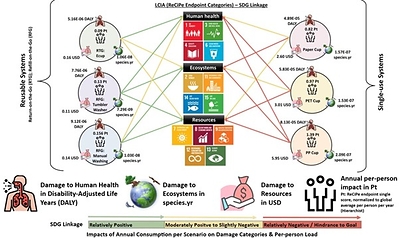
Using a comprehensive life-cycle assessment, the team compared refill-on-the-go (RFG) stainless-steel tumblers paired with the automatic washer, return-on-the-go (RTG) reusable polypropylene cups, and single-use paper, PET, and polypropylene cups.
The automatic tumbler washer system showed strong environmental performance. When paired with stainless-steel tumblers, it achieved the best results in more than half of the environmental impact categories assessed. RTG reusable cups recorded the lowest overall annual environmental impact because of their lightweight design and lower production footprint, while manually washed tumblers had the highest impacts among reusable options.
The researchers also examined contributions to the United Nations Sustainable Development Goals (SDGs). Overall, reusable systems outperformed single-use alternatives across human health, ecosystem, and resource-related SDG domains, with the automated tumbler washing system demonstrating the strongest overall sustainability performance.
The findings suggest that replacing disposable cups with reusable alternatives is only part of the solution. Maximizing environmental benefits requires efficient reuse infrastructure and operational practices. For universities, corporations, and municipalities, the study shows that the success of reusable systems depends not only on consumer participation but also on technologies that support reuse.
"Reusable systems support a circular economy, but efficient washing technologies are essential to maximize their long-term environmental sustainability," says Prof. Ok.
"Reuse culture must be supported by both top-down institutional interventions and bottom-up behavioral changes to accelerate the transition toward reusable systems," adds Ms. Ankareddy.
Together, the findings provide a practical roadmap for designing reusable beverage systems that maximize environmental benefits while advancing the transition to a circular economy.
Reference
Title of original paper: Environmental Trade-Offs and SDG Implications of Reusable Beverage Consumption Systems From a Life Cycle Perspective
Journal: Advanced Sustainable Systems
DOI: https://doi.org/10.1002/adsu.70534
Media contact:
Prof. Yong Sik Ok
Korea University and International ESG Association (IESGA)
E-mail: 418062@email4pr.com
Phone: 82-2-3290-3044
Image Title: Prof. Yong Sik Ok advances sustainable reusable beverage systems through life-cycle assessment
Image Caption: Prof. Yong Sik Ok of Korea University demonstrates how washing technologies and reuse infrastructure influence the environmental performance of reusable beverage systems through comprehensive life-cycle assessment.
Image Credit: Prof. Yong Sik Ok from Korea University, Seoul
Image link: https://doi.org/10.1002/adsu.70534
License type: CC BY 4.0
Usage restrictions: Credit must be given to the creator
 View original content to download multimedia:https://www.prnewswire.com/news-releases/korea-university-study-reveals-sustainability-trade-offs-of-reusable-beverage-systems-302817149.html
SOURCE Korea University

