OAKLAND COUNTY, MI - Drivers stopped on suspicion of impaired driving in Michigan may be asked to perform a series of roadside assessments known as field sobriety tests, which can establish probable cause for an OWI arrest. Oakland County OWI defense attorney Paul J. Tafelski of Michigan Defense Law (https://www.michigandefenselaw.com/field-sobriety-test.html) outlines how these tests work, how Michigan law governs their administration, and how the results may be challenged in court.
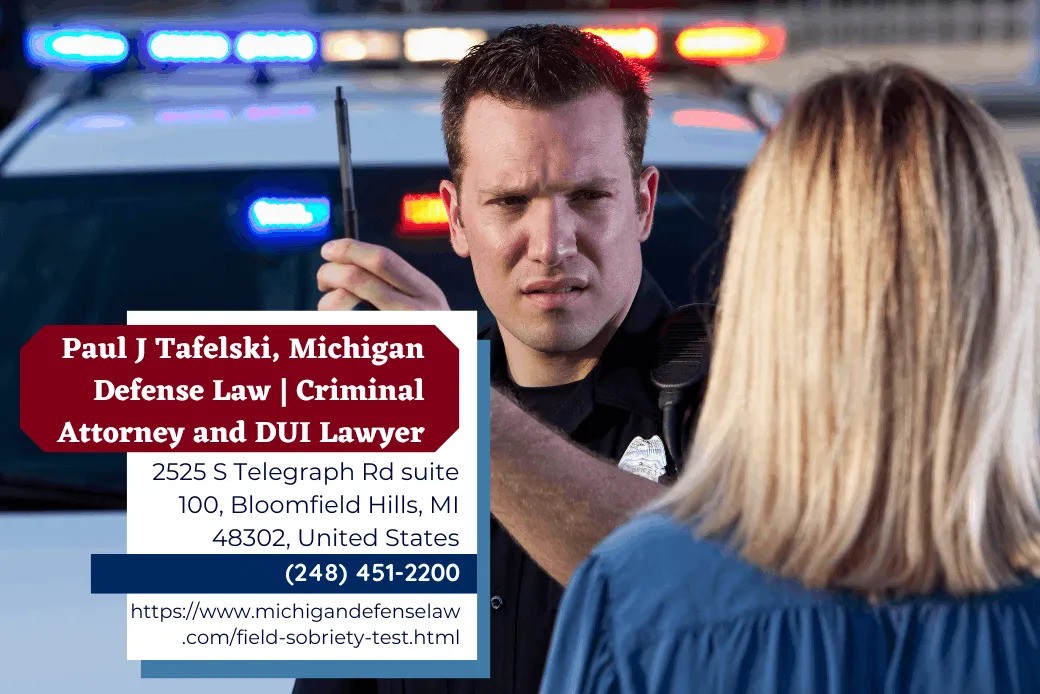
According to Oakland County OWI defense attorney Paul J. Tafelski, Michigan law under MCL 257.62a defines a "standardized field sobriety test" as one validated by the National Highway Traffic Safety Administration. This statutory definition matters because only tests administered in substantial compliance with NHTSA standards qualify as standardized field sobriety tests under Michigan law. "A test that does not meet that standard may not be admissible as an SFST, regardless of what the officer observed during the stop," Tafelski explains.
Oakland County OWI defense attorney Paul J. Tafelski notes that Michigan recognizes three standardized tests: the horizontal gaze nystagmus (HGN) test, the walk-and-turn test, and the one-leg stand test. Each test has specific scoring clues, and each must be administered according to NHTSA protocols. Under MCL 257.625s, an officer who testifies about SFST results must be qualified by knowledge, skill, experience, training, or education in the administration of those tests, and the prosecution must lay a proper foundation before the testimony can be admitted.
The HGN test involves observing involuntary jerking of the eyes as the subject follows a moving stimulus. NHTSA's standardized procedure looks for three clues in each eye, for a maximum of six clues. Attorney Tafelski points out that the Michigan Court of Appeals addressed HGN admissibility in People v. Berger, 217 Mich. App. 213 (1996), holding that HGN is scientific evidence with general acceptance and reliability, but only if "the test was properly administered by a qualified person." That decision frames the two principal challenges to HGN evidence: improper administration and inadequate officer qualifications.
The walk-and-turn and one-leg stand tests assess a driver's balance, coordination, and ability to follow instructions. The firm explains that scoring clues include difficulty maintaining balance during instructions, raising arms for stability, taking the wrong number of steps, and stepping off the line. Many medical and physical conditions can produce these clues without any impairment, including arthritis, inner ear disorders, neurological conditions, eye conditions, and certain medications. Footwear, age, and the surface where the test is conducted can also affect performance.
Tafelski emphasizes that field sobriety test results are not conclusive proof of intoxication. They are screening tools that can establish probable cause for an OWI or operating while visibly impaired (OWVI) arrest. Under Michigan law, a blood alcohol content of 0.08 or higher can result in an OWI charge, while a BAC of 0.17 or higher triggers Michigan's high BAC offense, which carries more severe penalties. "SFST results are one piece of the prosecution's case, but they are not the final word, and they can be challenged on multiple grounds," Tafelski observes.
Michigan Defense Law also addresses non-standardized tests, such as reciting the alphabet backward or finger-to-nose testing. While these tests have not been validated by NHTSA, Michigan's 2016 Public Act 242 clarified that the standardized framework under MCL 257.62a does not preclude the admissibility of non-standardized tests that comply with the Michigan Rules of Evidence. The firm reviews dashcam and bodycam footage to determine whether the officer followed proper procedures and whether deviations from NHTSA standards justify a motion to suppress.
Drivers in Michigan can refuse a field sobriety test without triggering automatic license penalties, which apply only to preliminary breath tests and post-arrest chemical tests. However, refusal does not end the investigation, and an officer may still establish probable cause through other observations. Anyone arrested after a failed SFST should remain calm, invoke the right to counsel, and document the conditions of the stop as soon as possible.
For Oakland County drivers facing OWI charges based on field sobriety test results, an experienced defense attorney can review the testing process, evaluate the officer's qualifications, and identify procedural errors that may support a motion to suppress.
About Michigan Defense Law:
Michigan Defense Law is an Oakland County-based criminal defense firm focused on OWI defense, traffic offenses, and felony cases. Led by attorney Paul J. Tafelski, who has practiced law in Michigan for over 20 years and has been recognized by Super Lawyers, the firm represents clients throughout Oakland County and across Michigan. For consultations, call (248) 451-2200.
Email: paul@michigandefenselaw.com
Media Contact
.png)
Name
Paul J. Tafelski, Michigan Defense Law
Contact name
Paul J. Tafelski
Contact phone
(248) 451-2200
Contact address
2525 S Telegraph Rd suite 100
City
Bloomfield Hills
State
Michigan
Zip
48302
Country
United States
Url
https://www.michigandefenselaw.com/
COMTEX_483507902/2888/2026-06-09T13:32:39
